

You catch your reflection in a shop window on a grey Tuesday in town, and there it is: skin that looks a little flat. A bit tired. Not bad, exactly — just missing that lit-from-within thing it used to do on its own. You haven’t changed anything. So why do you have dull skin that looks duller than it did a few years ago?
Here’s the reassuring part: dullness is one of the most fixable things in skincare. It’s rarely about doing more. Usually it’s about doing one or two things that actually matter. Let’s get into why skin goes dull in the first place — and the simplest honest way to bring the light back.
Glowing skin is, quite literally, skin that reflects light evenly. A healthy surface is smooth, so light bounces off it in one clean direction and your face looks luminous.
Now picture the opposite. Your skin renews itself on roughly a monthly cycle, shedding dead cells from the surface to reveal fresh ones underneath. When that process slows — and it slows with age, cold weather, stress and dehydration — dead cells pile up unevenly on the surface. That rough, cluttered layer scatters light in every direction instead of reflecting it cleanly. Your eye reads that scattered light as dull: grey, flat, tired.
So “brightening” isn’t about bleaching your skin or chasing some filter-perfect glow. It’s about clearing that uneven layer of dead cells so light can do its job again. Hold that thought — it’s the key to everything below.
Most articles hand you nine causes and let you sort it out. We’d rather rank them by how much they actually matter:
Notice that four of the five resolve faster once you tackle number one. That’s the whole strategy.
If your skin looks duller from roughly October to March, you’re not imagining it — and you’re not doing anything wrong. Irish living conditions are quietly tough on radiance:
Low winter light and damp, cold air slow surface renewal and leave skin looking grey.
Central heating pulls moisture out of the air (and your skin), tipping you into the dehydration that makes dullness worse.
Hard water, common across much of Ireland, can leave mineral residue on the surface, adding to that filmy, flat look.
None of the big global skincare guides mention any of this, because they’re not written for an Irish bathroom in February. The fix is the same science — but knowing why your skin dips in the Irish winter is half the battle.
These two get muddled constantly, and the distinction changes what you reach for.
| Dull skin | Dehydrated skin | |
|---|---|---|
| Core issue | Rough surface / dead-cell build-up scattering light | Skin lacking water |
| Looks like | Grey, flat, “tired,” uneven | Flat, papery, fine lines more visible |
| Quick test | Light doesn’t bounce; makeup sits unevenly | Pinch a cheek — slow to bounce back = dehydrated |
| First move | Gentle exfoliation to clear the surface | Humectants (hyaluronic acid, glycerin, urea) + barrier support |
In real life they overlap: dehydrated skin almost always looks dull too. The good news is that a well-built routine handles both — exfoliate the surface and feed it water.
If you only change one thing, change this: swap aimless scrubbing for gentle chemical exfoliation, and protect the result with daily SPF.
Physical scrubs feel productive but can scratch the surface and worsen dullness over time. Chemical exfoliants — the acid family known as AHAs and BHAs — work differently: they gently dissolve the “glue” holding dead cells together, so the cluttered surface clears evenly and fresh skin shows through. That’s how you get glow that looks like skin, not like a filter.
One sensible note: anything that resurfaces also makes skin more sun-sensitive. So daily SPF isn’t optional here — it’s the other half of the routine. Our Sun Protect+ SPF 50 was built to be the easy, wear-every-day partner to an exfoliating step.
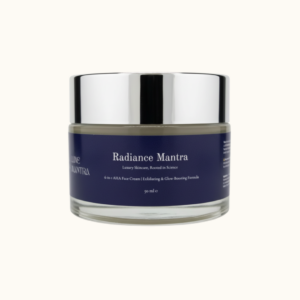
Here’s where it gets genuinely interesting — and where our Radiance Mantra cream earns its name. Rather than one acid doing one job, it pairs three acids that each work on a different problem at the same time. Think of them as a small, well-coordinated crew:
Glycolic acid — the surface polisher. The smallest AHA, water-soluble, working right on the top layer to loosen dead-cell build-up and improve smoothness and brightness. Your primary “dullness” worker.
Salicylic acid — the pore specialist. Oil-soluble, so it can get into the pore lining rather than just sitting on top. It targets the congestion and build-up that also dull the complexion.
Azelaic acid — the tone-evener. The quiet multitasker, helping improve the look of uneven tone and post-blemish marks for a more refined, even-looking finish.
Three acids, three jobs, one step. And because resurfacing acids can feel stripping on their own, the formula cushions them with glycerin, propanediol and aloe to bind water, plus a pair of antioxidants — vitamin E and a touch of vitamin C (ascorbic acid) — for extra brightness support. That’s the “premium, simplified” idea in practice: one intentional formula instead of three separate acids you’d otherwise buy, layer and hope don’t clash.
A note on honesty: Radiance Mantra is lightly fragranced. For most people that’s a non-issue, but if your skin is genuinely reactive or rosacea-prone, a fragrance-free route is kinder — and we’ll always tell you that rather than pretend one product suits everyone.
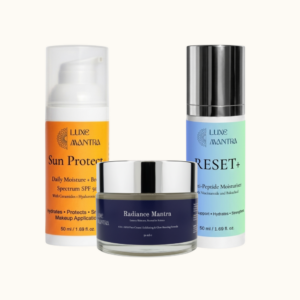
You don’t need a shelf of products. You need the right few, used consistently:
That’s it. Four steps, most of them ten seconds. Glow is a consistency game, not a complexity game.
Realistic expectations: you may notice skin feels smoother quite quickly, but visible brightness builds over a few weeks of consistent use — not overnight. Anyone promising instant transformation is selling you something.
What is the fastest way to fix dull skin? The single most effective change is gentle chemical exfoliation (AHAs/BHAs) two to three times a week to clear dead-cell build-up, paired with daily SPF to protect the fresh surface. This clears the rough layer that scatters light and dulls the complexion.
Why does my skin look dull in winter? Cold, damp air and low light slow your skin’s natural renewal, while central heating dehydrates the surface. Both leave more dead cells sitting unevenly on top, scattering light and looking grey — a common pattern in the Irish winter.
Is my skin dull or dehydrated? Dull skin is mainly a surface texture problem — dead cells scattering light. Dehydrated skin lacks water and looks flat and papery. They often occur together. Quick check: pinch your cheek; if it’s slow to bounce back, dehydration is part of the picture.
Can glycolic acid help dull skin? Yes. Glycolic acid is a water-soluble AHA that works on the skin’s surface to loosen dead-cell build-up, supporting smoother, brighter-looking skin. It’s one of the most studied ingredients for radiance.
Do I need SPF if I’m using exfoliating acids? Yes — daily, without exception. Exfoliating acids make skin more sensitive to UV, so sunscreen protects your results and prevents new uneven tone and dullness.
How long until I see brighter skin? Skin often feels smoother within days, but visible brightness typically builds over a few weeks of consistent use. Slow and steady protects your barrier and gives better long-term results.